A Northern California Racing Tradition, 1949–Present
From Schaad Ranch to the Modern Era — and the 2026 “Back To The Roots” race.
Origins: A Fun Ride Among Friends, 1949
Every great race starts small. The Wilseyville Hare Scrambles began in 1949, not as a sanctioned championship event but as an informal fun ride organized by the original members of the Blue Mountain Timberwolves Motorcycle Club — most of the Noble family, along with friends Floyd Hudson and Floyd Porteous, several riders from the Polka Dot Motorcycle Club, and Johnny Schaad.
The ride started in Wilseyville, at what was then Schaad’s Resort, and climbed over Blue Mountain to Dorington and back. What began as a leisurely group ride soon turned competitive — first a friendly race to the lunch stop, then, on the return leg, a race back to the beer cooler. Out of that spirit of rivalry among friends, an annual tradition was born.
As the event matured, it settled into the lap-race format that off-road racing fans would recognize today: big bikes running six laps, small bikes running four. In the earliest years, riders competed on modified road bikes, since purpose-built dirt motorcycles didn’t yet exist — the first true dirt-specific enduro machines, the 1968 Yamaha DT-1 enduro models, were still nearly two decades away.
The Golden Era: Wilseyville Becomes a Proving Ground
By the mid-1960s, Wilseyville had earned a reputation as one of the toughest tests on the West Coast racing calendar. That reputation drew international attention in 1966, when Swedish motocross champion Torsten Hallman — then in the process of introducing European-style motocross to American audiences — made his Wilseyville debut alongside Bryan Kenney, Malcolm Smith, and AMA legend Dick “Bugsy” Mann.
Contemporary racing coverage captured just how tough that debut was. Cycle World’s February 1967 racing review referenced Hallman’s Wilseyville appearance in the same breath as his other marquee North American starts, noting that Wilseyville and Hope Town were the only U.S. events long and hard enough to give him a proper test — most other closed-circuit races of the era, the magazine complained, were being run “too short and easy.”
“Rain began falling hard as we headed to the start. I thought California was full of sunshine, and I’d only brought a few t-shirts to ride in!” — Torsten Hallman, recalling his Wilseyville race
Hallman’s own account of the race describes a field of roughly 200 to 250 riders lined up in the rain, his bike refusing to start on the first kick, and a hard-fought comeback through the pack. He caught every rider but one — Dick Mann, aboard a BSA — and spent much of the race stalking him before deciding to make his move, passing Mann in the closing laps to win going away. It’s exactly the kind of muddy, rain-soaked drama that would come to define Wilseyville’s identity for the next half-century.
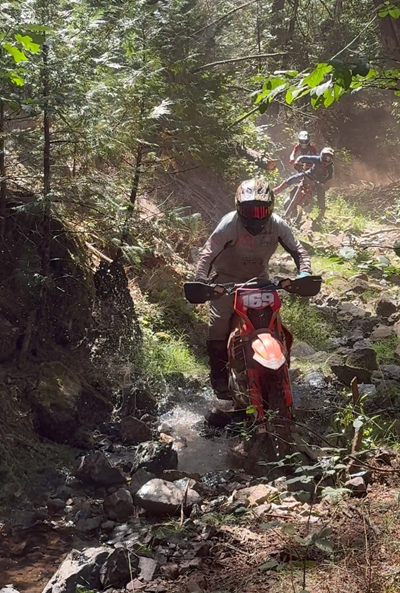
That identity was no accident of scheduling. Held every November, the race falls squarely in Northern California’s rainy season, and the ranch’s red clay soil turns notoriously, treacherously slick when wet. Generations of racers have called Wilseyville one of the original West Coast technical tracks for exactly this reason — dust in a dry year, axle-deep mud and red clay in a wet one, and no way to know in advance which race you’ll get.
Legends on the Entry List
Over more than seven decades, the Wilseyville entry list reads like a cross-section of American off-road racing history. Early stars like Bugsy Mann, Hallman, and Paul Edmondson gave way to later generations of champions — Chris Carr, the Garrahan family, the Oliveira brothers, and, in the most recent era, Trystan Hart, Zane Roberts, and Ricky Russell.
The names carry through the decades in the results sheets. A 2009 running of the event — held at Schaad Ranch as Round 13 of the District 36 Western Regional Cross Country Series — was won by a young Justin Bonita, with Patrick Garrahan taking second on a KTM 150 to clinch the season’s District 36 title. In 2017, SRT Husqvarna’s Trystan Hart drove through the night straight from an EnduroCross finale in Ontario, California, to make the start line and win by more than a minute. By 2024, GNCC transplants Josh Toth and Ricky Russell were making their own Wilseyville debuts, drawn by the event’s reputation clear across the country.
The Snow National
Among the countless stories Wilseyville veterans still trade in the pits, one stands above the rest: the February National that turned into a snow race. Riders and course workers arrived Saturday to find more than a foot of snow blanketing the course overnight, burying the ribbon and arrow markings that guide riders through the woods. After a delay of a couple of hours spent digging out the course markings, organizers sent the race off as scheduled — producing, by all accounts, one of the most talked-about editions in the event’s history, and no shortage of pit-side stories and impromptu racing well after the checkered flag.
It’s a fitting encapsulation of the Wilseyville reputation: a race that has been run in dust, heat, driving rain, and — at least once — deep snow, and one that racers kept coming back for regardless.
2012: The Race Leaves Schaad Ranch
For decades, Wilseyville meant Schaad Ranch. The event was run there as a fixture of the District 36 racing calendar, hosted with the generosity of the Schaad family on land that had supported the race, in one form or another, since 1949.
That changed in 2012. When part of the Schaad Ranch property was sold, the 2012 running turned out to be the last for the foreseeable future — the 2013 event was formally cancelled. District 36 CC Steward Kraig Traum announced that that 2+2 Racing, who had run the event for years, cancelled the race. 2+2 Racing made the decision to cancel with evident sadness, thanking the Schaad family for hosting the race for so long and thanking racers for “all those great years in dust, heat, rain and the epic snow races.” Longtime racers responded with their own memories — of a seven-mile-long rut, of bikes stuck up trees, of finishing in the dark by headlight, and of running battles fought lap after lap on the vintage bikes.
The loss was felt well beyond the immediate racing community. NorCal Motorcycle Club spent the better part of two years working with area landowners to secure new ground and cut new trail, and the race returned in 2015 on Halloween weekend — its history intact, but its home changed. “This event had been around since 1949 and it was a huge loss to the motorcycling community when it was cancelled a few years ago,” NorCal MC president David Furrer said at the time. “The whole town of Wilseyville is behind us, and we will work hard to restore this event to its historical greatness.”
The Modern Era at Lodestar Ranch
Since its 2015 revival, the Wilseyville Hare Scrambles has run primarily at Lodestar Ranch, growing into one of the largest and most prestigious rounds of the AMA West Hare Scrambles Regional Championship Series. The numbers tell the story of its continued popularity: the 2021 running — the 68th annual — drew an official tally of 990 entries, making it the single biggest race of that season. The event has regularly drawn crowds estimated at 750 riders and spectators in recent years, alongside vendors and support from the Calaveras County Sheriff’s Office.
In 2018, the 65th annual race was run as “Race4Paradise,” with all proceeds from the event donated to victims of the Camp Fire in Butte County — a reminder that the race has remained, throughout its history, as much a community institution as a competition.
The event has also stayed a family affair in the truest sense. Denise and Rick Schaad’s grandson, Maverick Alaway, grew up riding on the family ranch and went on to compete in — and win — his “hometown race” at Wilseyville, carrying the Schaad name back onto the entry list even during the years the race itself was held elsewhere.
2026: The Return to Schaad Ranch
This November, for the first time since 2012, the Wilseyville Hare Scrambles returns to the ground where it built its reputation. Much of the course will follow old trail alignments that have been ridden since the beginning of the event — familiar, evocative names among them, including the appropriately titled Slippery Rock and Ball Bearing Hill, obstacles that generations of racers have learned to respect and fear in equal measure.
Not everything is unchanged. Boston Flat, the traditional start-and-finish area, has been sold and is now used to round up cattle, so riders will start and finish this year’s race from a new location on the property. But the heart of the course — the red clay, the creek crossings, the technical single-track that made Wilseyville famous in the first place — returns to the land that shaped it
We welcome the opportunity to hold the race back here on
the land that has supported so many racers over the years.
For a race that has run through mud, dust, rain, and a foot of snow — and that has weathered its own multi-year absence from the ground where it began — the 2026 homecoming closes a circle nearly eighty years in the making.
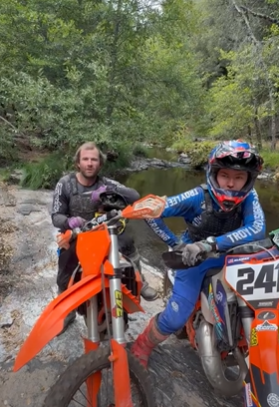
The 2026 running also marks a new chapter in the race’s sponsorship, with Maverick Alaway and his trainer, Anson Maloney, stepping forward as the event’s new sponsors — a fitting continuation given Alaway’s own roots on the Schaad family ranch.
Honorable Mention: The Clubs That Kept It Alive
No history of the Wilseyville Hare Scrambles is complete without recognizing the clubs whose members organized, promoted, and worked the course year after year to keep the race running. The Polka Dot Motorcycle Club, present among the race’s original riders back in 1949, remained a fixture of the Northern California off-road community that supported Wilseyville’s growth in the decades that followed. And for many years, it was 2+2 Racing that put on the race itself, building the course, marshaling the volunteers, and keeping the event alive through dust, rain, and the epic snow races, right up until the Schaad Ranch era came to a close in 2012.
Their work, alongside NorCal Motorcycle Club’s efforts to revive and sustain the race in the years since, is a large part of why the Wilseyville Hare Scrambles survives to be run today.
A Note on Sources
This history draws on firsthand recollection from longtime participants and organizers, supplemented by period racing coverage (Cycle World, Cycle News), contemporaneous club and District 36 announcements, and race-day reporting from recent seasons. Some early details — including the exact founding roster of the Blue Mountain Timberwolves and the precise year of the snow-buried February National — are preserved here as they are remembered within the racing community; readers with photographs, programs, or firsthand memories from those years are warmly encouraged to help fill in the record.